

















With all of its features, tools, and benefits, Amazon advertising can be overwhelming for eCommerce businesses at first glance – but also very lucrative! However, one strategy that may help you get on top in this competitive market is using automatic targeting on Amazon, especially if you are a PPC beginner.
In this blog, we’ll look at when it is optimal to use Amazon automatic targeting, types of automatic targeting, and the best strategies to make the most of automatic targeting.
Want to see how real brands turn Amazon advertising into profitable growth? Check out our Success Stories to see how Trellis helps businesses scale smarter with AI-driven strategy.
Key Insights
- Amazon automatic targeting is a starting point, not a full strategy. It helps you discover keywords and audiences, but long-term success comes from refining and scaling what works.
- Data is the real value of automatic campaigns. Search term reports and performance insights allow you to identify winning keywords, reduce wasted spend, and improve results over time.
- Profit comes from connecting the full system. Your ads, pricing, product content, and promotions must work together to drive sustainable growth, not just traffic.
What is Amazon Automatic Targeting?
Automatic targeting allows Amazon to decide where and when a product ad is displayed. This type of ad targeting focuses on keywords that Amazon’s algorithm deems relevant to multiple elements of a product listing including, the title and description.
In automatic targeting, Amazon optimizes advertising campaigns over time by collecting data from shoppers’ purchases and adjusts ads accordingly to increase conversion and click-through rates.
Increase Amazon Sales By 30%
Our Advanced Amazon PPC Guide is everything you need to take your Amazon profits to the next level.
What are the Benefits of Automatic Targeting?
Automatic targeting is ideal for sellers that are new to Amazon advertising and are looking to explore their target audiences. Moreover, it is also suitable for those who want to get started with Amazon advertising but are unsure of where to begin in terms of bidding and finding new keywords.
Automatic targeting can help increase the visibility of your products and generate desired outcomes if you don’t have the time to monitor and manage manual advertising campaigns.
What are the Different Types of Automatic Targeting?
Amazon allows four different match types for automatic targeting. These include:
- Close Match
- Loose Match
- Substitutes
- Complements
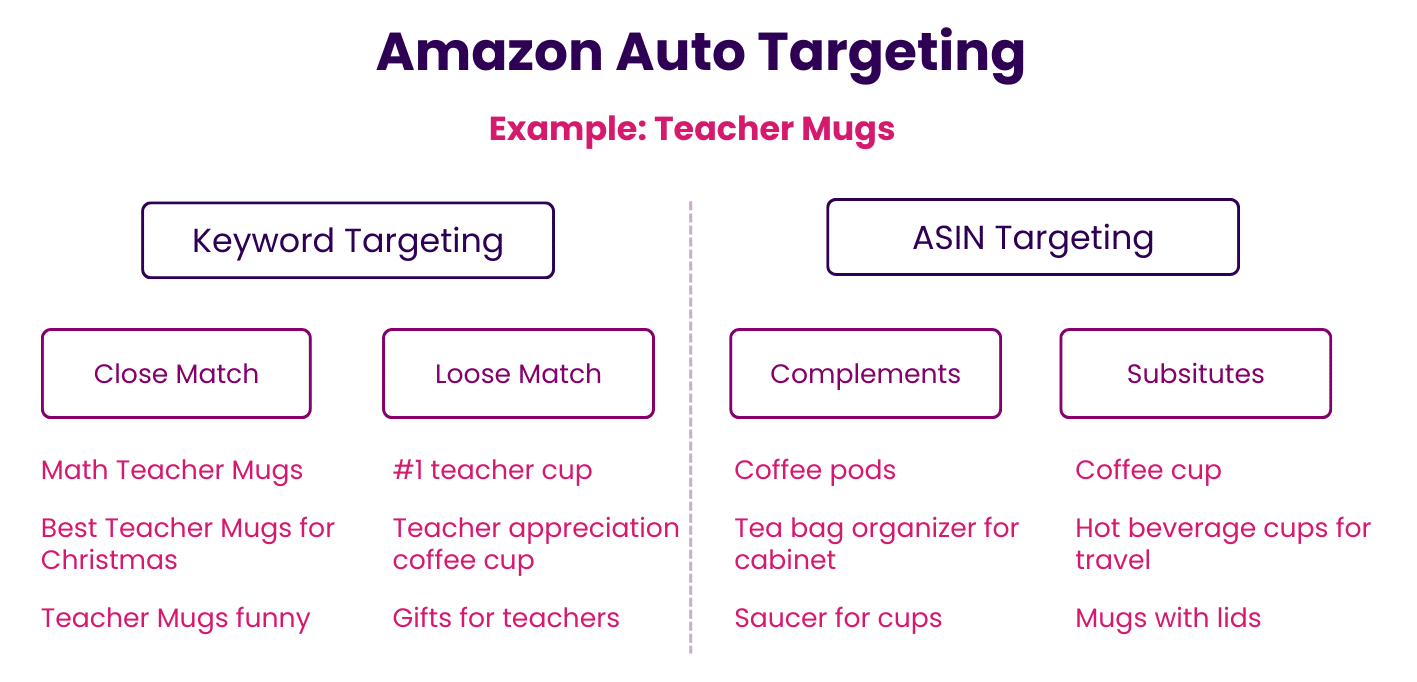
Overview of Close Match and Loose Match
Close Match and Loose Match are used for keyword targeting whereas, Substitutes and Complements target products. Close Match and Loose Match represent the extent of closeness to the keywords used in a product listing. Therefore, a product ad becomes eligible to be shown in the search results if the product matches closely or loosely with the query of a shopper.
Examples of Close Match and Loose Match
Here is an example of how a Close Match works on Amazon. Let’s say you are selling pet shampoo. In that case, you would get impressions for pet shampoo for dogs and pet shampoo for cats.
In the case of a Loose Match, Amazon matches keywords more liberally. This is crucial to boost brand awareness and enhance product discoverability. An example of this is that the keyword ‘gloves’ can match with ‘thermal gloves’ and ‘winter gloves’.
Overview of Substitutes and Complements
With Substitutes and Complements, ads for products that are substitutes or complements for another product are shown to shoppers that land on the detail pages of that product.
Examples of Substitutes and Complements
Substitutes also play a key role in raising brand awareness and work as an ideal solution for new entrants on Amazon. An example of how automatic targeting works, in this case, is that if you are selling sandals, you would get impressions for flip-flops.
Complements help drive traffic from products that add value to what you are selling. A quick search showed us that for the example of ‘hair dryer’, it is possible to get visibility for products such as ‘hair dryer wall mount’ and ‘hair dryer case’. This is an excellent way of increasing impressions through additional sources that you were not using before.
Should I Use Automatic vs. Manual Targeting?
As the name suggests, manual targeting is when Amazon sellers determine the keywords and bids for their advertising campaigns. This type of strategy is more effective for sellers and businesses that have prior targeting experience. In addition to that, it is also useful for sellers that have an understanding of the keywords they intend to target through their campaigns.
Automatic Targeting
With automatic targeting, Amazon chooses where your ads appear. It uses your product listing, keywords, and shopper behavior to match your ads to searches and product pages.
- Less control over targeting
- Faster to set up
- Best for discovery and testing
Manual Targeting
With manual targeting, you choose the keywords or products you want to target. You also control match types and bids.
- Full control over targeting
- Requires data and ongoing optimization
- Best for scaling and improving efficiency
To make an informed decision about automatic or manual targeting, it is best to determine whether you have comprehensive knowledge of Amazon PPC. For a comparative analysis of automatic vs manual targeting on Amazon, read our complete guide here.
When Should I Use Amazon Automatic Targeting?
Amazon automatic targeting works best when you need data, speed, or broader reach. It is not just for beginners. It is a tool that helps you understand how shoppers find your products.
Launching a New Product
When you launch a new product, you likely do not have keyword data yet. Automatic targeting helps generate early impressions, clicks, and sales signals. This gives Amazon the data it needs to start matching your product to relevant searches.
Discovering New Keywords
Automatic campaigns are one of the fastest ways to find high-performing search terms. By reviewing your search term reports, you can identify which keywords drive clicks and conversions. You can then move those into manual campaigns to gain more control.
Expanding Your Reach
Manual campaigns rely on the keywords you choose. Automatic targeting helps you reach long-tail and related searches that you may not think to target. This is especially useful in competitive categories where new opportunities appear often.
Testing New Products or Variations
If you are launching a new variation or entering a new category, automatic targeting helps validate demand. It allows you to test performance without building a full keyword list upfront.
Supporting Manual Campaigns
Automatic campaigns work best when paired with manual campaigns. They fill gaps, uncover new opportunities, and provide ongoing data that improves your overall strategy.
What is the Best Strategy to Make the Most of Automatic Targeting?
Whether you are an Amazon advertising beginner or a master, optimization is key!
When opting for automatic targeting on Amazon, sellers have no control over their bids which can lead to a higher Amazon ACoS. This is because the bids for high, medium, and low converting (or even negative keywords) are equal.
Many sellers feel discouraged at the prospect of losing their ad spend when implementing automatic targeting ad campaigns. Therefore, it is imperative to constantly analyze data trends to help your campaign perform better and introduce new strategies such as manual targeting.
Moreover, as you try to navigate your Amazon PPC campaigns, you can also consider using an advertising automation platform such as Trellis to boost effective demand in a competitive eCommerce landscape.
Want quick, actionable insights like this every month? Subscribe to The Climb, Trellis’ newsletter designed to help your eCommerce business grow step by step.
How to Add Negative Keywords to Reduce Wasted Spend
Automatic campaigns can drive a lot of traffic. Not all of it will be relevant. Adding negative keywords helps you remove low-quality traffic and improve performance.
Step 1: Review your search term reports
Start by looking at your search term report. Focus on:
- High spend with no conversions
- High clicks with low performance
- Irrelevant search queries
Step 2: Identify poor-performing terms
Look for patterns. Some keywords may drive traffic but not sales. Others may not match your product at all. These are strong candidates for negative keywords.
Step 3: Add negative keywords
There are two main types:
- Negative exact blocks a specific search term
- Negative phrase blocks variations of that term
Use negative exact for precise control. Use negative phrase to block broader patterns.
Step 4: Apply them at the right level
You can add negative keywords at the campaign or ad group level. Keep your structure organized so you can track performance easily.
Common Mistakes With Amazon Automatic Targeting
Automatic targeting can be powerful, but it is often misused. These mistakes can lead to wasted spend and missed opportunities.
- Treating it as set-and-forget: Automatic campaigns still need regular monitoring. Without optimization, performance will decline over time.
- Not using search term data: The biggest value of automatic campaigns is the data they provide. If you are not reviewing search term reports, you are missing key insights.
- Not adding negative keywords: Irrelevant traffic can quickly increase your costs. Without negative keywords, your campaigns may spend on searches that will never convert.
- Running only automatic campaigns: Automatic campaigns are not a complete strategy. Without manual campaigns, you lose control over targeting and bidding.
- Poor product listings: Amazon relies on your product title, keywords, and content to match your ads. Weak listings lead to poor targeting and lower performance.
- Not adjusting bids: Default bids are rarely optimal. You need to adjust bids based on performance to stay competitive and efficient.
- Expecting immediate results: Automatic campaigns often go through a learning phase. It takes time to gather enough data to make informed decisions.
How Trellis Can Help With Amazon Automatic Targeting
Essentially, Trellis automates bidding and pricing through AI algorithms. It also lets you control bidding on individual keywords. While you get the benefits of Amazon Auto Campaigns, you have similar control of Manual Campaigns.
Amazon automatic targeting is the perfect launchpad for PPC beginners. However, Trellis makes campaign optimization simpler which lets any advertiser, regardless of experience or time, gets the desired result quickly.
Advertising automation solutions such as Trellis can dynamically manage your bids based on data-driven insights, that too in real-time. With 1B+ bids managed so far and a roster of 200k products in the system, Trellis is the ultimate demand generation platform for Amazon.
If you want to move from trial-and-error to consistent growth, Trellis can help you get there faster – book a demo to see how it works.
In Summary
Amazon automatic targeting is a powerful way to launch campaigns and gather data, but it works best as part of a larger strategy. The real value comes from using that data to refine your targeting, reduce wasted spend, and improve performance over time.
When you connect automatic campaigns with manual targeting, smart bidding, and strong product content, you create a system that drives consistent growth. That’s where tools like Trellis make a difference, helping you turn insights into action and scale your business with confidence.
Increase Amazon Sales By 30%
Our Advanced Amazon PPC Guide is everything you need to take your Amazon profits to the next level.