

















Amazon Advertising Cost of Sale (ACoS) is widely used by Amazon sellers and third-party brands to determine the profitability of Sponsored Products, Sponsored Brands, and pay-per-click (PPC) campaigns.
As competition swells, one of the best ways to grow your sales is through advertising—but it’s not about growth at all costs. To drive long-term profitability with your Amazon PPC campaigns, it’s important to understand the actual cost of advertising from the beginning.
This guide will help you understand why ACoS is important, how to calculate it, and what your target should be. We’ll also share advanced optimization tips to improve ACoS no matter what category you’re in.
Calculate your target ACoS in seconds. Try the free Amazon ACoS calculator and find your target ACoS.
A good target depends on where your product is in its lifecycle. In the launch phase, a higher ACoS (30–50%) helps gather data and build ranking. During growth, aim for 20–30%. Mature products typically stabilize at 10–20%. Lower ACoS isn’t always better—it must align with your strategy, margins, and goals.
Find your sweet spot: Use the ACoS Calculator to determine your break-even and growth-phase targets.
Key Insights
- ACoS measures advertising efficiency, not overall profitability. To understand true performance, you must factor in profit margins, Amazon fees, and total revenue.
- There is no universal “good” ACoS. Your ideal target depends on product lifecycle stage, margin structure, and growth goals.
- Lowering ACoS requires improving multiple levers. Better Product Content, smarter Placement, optimized Pricing, and strategic Promotion all work together to improve performance.
What Is Amazon ACoS?
ACoS is an Amazon-specific metric that measures how much you spend for every dollar of revenue you make. Amazon ACoS is expressed as a percentage. It is essential in helping Amazon sellers understand the efficiency and profitability of their campaigns.
Sellers who optimized toward phase-appropriate ACoS targets, rather than a single fixed goal, achieved 31% higher profit.
How to Calculate ACoS for Amazon PPC
Here’s the formula for calculating ACoS on Amazon:
ACoS = Ad Spend / Ad Revenue X 100
If you spend $60 on an Amazon PPC campaign and gain a total sales revenue of $200, here’s how you would calculate ACoS:
$60 / $200 X 100 = 30%
This result means that you spent $0.30 for every $1.00 the campaign earned.
📌 Note: ACoS does not include other expenses like ad production and Amazon fees. It only measures your ad spend, i.e. the budget you listed when you set up your Amazon campaign.
Why Is ACoS So Important?
Amazon’s ACoS metric evaluates your PPC campaign’s profitability and efficiency so you can optimize your Amazon ads and win more sales.
Continuously evaluating ACoS is key to:
- Determining whether your campaign is profitable.
- Making adjustments to your advertising strategy to improve efficiency.
With rising Amazon seller fees, it’s getting harder for brands to maintain margins. By monitoring your ACoS, you can ensure that your Amazon advertising strategies not only drive sales, but do so profitably.
Want to see how real brands lowered ACoS and improved profitability? Explore Trellis Success Stories to see how AI Precision + Human Intuition helps sellers scale smarter, not harder.
What’s the Difference Between Amazon RoAS and ACoS?
Return on ad spend (RoAS) is the inverse of ACoS. It shows how much revenue you get for every dollar you spend on advertising, while ACoS shows how much you spend for every dollar you make.
RoAS is more common in PPC, but both key metrics help you determine your campaign’s effectiveness. RoAS is better for evaluating how effective your total ad spend is, while ACoS is better for measuring profitability.
How does your RoAS stack up? Find out here: What is a Good Amazon RoAS?
What’s the Difference Between Amazon ACoS and TACoS?
What if someone saw your ad and then bought your product later from an organic recommendation?
Total advertising cost of sale (TACoS) extends beyond ACoS by including organic sales with paid, providing a holistic view of your advertising efficiency. While ACoS directly measures ad spend to sales, TACoS shows how your advertising impacts overall sales and brand growth.
This broader perspective can help you optimize your ad strategies for better overall business performance.
Should you be tracking TACoS? Here’s everything you need to know: What is Amazon TACoS?
What’s a Good ACoS on Amazon?
There’s no universally “good” or “bad” ACoS. Amazon ACoS varies by product, industry, ad type, and campaign. That said, you’ll find that most Amazon sellers have a target advertising cost of between 25-35%.
An average of less than 25% is generally considered a low ACoS in most industries, while anything beyond 35% is considered high. However, to really understand your Amazon ACoS, you have to give it the proper context.
Start by comparing your ACoS to other sellers in the same country, industry, and sub-category. Make sure their ads are the same format as yours. Then, consider your Amazon PPC campaign goals.
While a lower ACoS is usually better, there may be situations where you want target a higher ACoS, such as:
- Introducing a new product
- Building brand awareness
- Securing the Buy Box
- Dominating a competitive niche
- Offloading a low-selling ASIN
If your focus is profitability, your goal will be to maintain an ACoS that is lower than your profit margin.

Amazon ACoS Benchmarks
With so much nuance around what makes an ACoS good, it’s difficult to know the exact average ACoS metrics. However, here are some broad guidelines:
- < 25% : Generally considered a low ACoS
- 25-35% : Typical ACoS target range
- > 35% : Generally considered a high ACoS
For Sponsored Brands campaigns, you can evaluate ACoS relative to your peers with the category benchmark report, which shows the median, top 25%, and bottom 25% metrics by product category.
ACoS by Product Lifecycle Stage
Your target Amazon ACoS should change as your product moves through its lifecycle. A launch strategy is not the same as a mature profitability strategy. If you use the same ACoS target for every stage, you risk slowing growth or limiting profit.
Product Launch Stage
During launch, your goal is visibility and data. Your product may have few reviews and no ranking history. You are investing to gain traction.
It is common to tolerate a higher ACoS during this stage. In competitive categories, that may range from 40% to 70%, depending on your margins. The goal is to build keyword rank, increase sales velocity, and gather conversion data.
Monitor Total Advertising Cost of Sale (TACoS) during this stage. If organic sales start rising while TACoS stabilizes, your strategy is working.
Growth Stage
In the growth phase, your product has momentum. Organic rankings improve. Conversion rates become more predictable.
This is when you begin tightening ACoS targets. You refine keyword targeting, reduce wasted spend, and improve click-through rate (CTR) and conversion rate.
You are shifting from aggressive visibility to controlled scale.
Mature Stage
In the mature phase, your product ranks organically and generates consistent sales. At this point, ACoS targets typically fall between 15% and 30%, depending on your profit margin.
Your focus becomes efficiency. You defend branded keywords, optimize Cost-Per-Click (CPC), and protect market share. Advertising supports profitability, not experimentation.
ACoS should reflect where your product stands today, not where it started.
How to Find Your Target ACoS
Getting the most out of an Amazon ad campaign starts with finding your target ACoS. This will depend on how much you’re willing to invest in advertising.
Determine your target Amazon ACoS in three steps:
- Know your profit margin
- Calculate the break-even point of your ACoS
- Find your target ACoS
Let’s take a closer look at each step to help you find your target ACoS.
1. Know Your Profit Margin
Profit margin factors in production costs, Amazon fees, and shipment fees (both from the manufacturer and to customers).
If you you’re selling without ads, your profit margin calculation will be:
Profit margin = (product price – production costs – Amazon fees – shipment fees) / product price X 100
For instance, if a product sells at $150, costs $40 to produce, incurs $20 in Amazon fees, and costs $30 to ship, your profit would be:
$150 – ($50 + $20 + $30) = $50
To get the profit margin, divide the profit by the product price X 100.
$50 / $150 X 100 = 33%
Your profit margin before advertising costs would be 33%. Next, you need to determine the break-even point to help you find your target ACoS.
2. Calculate Break-Even ACoS
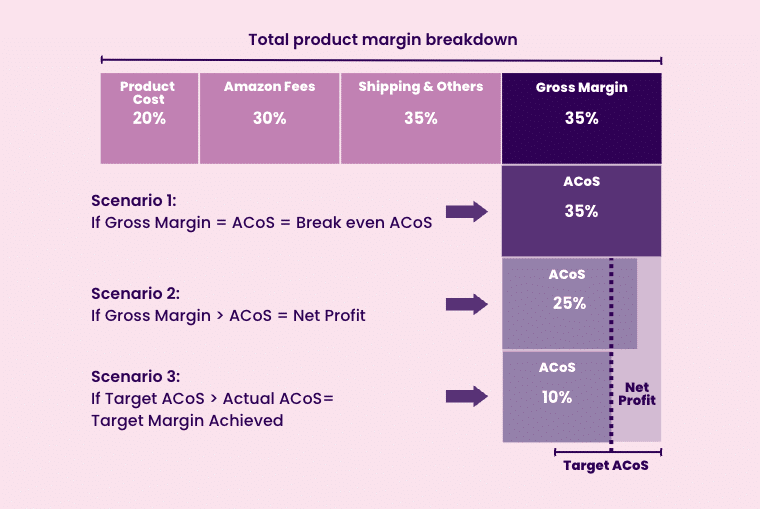
Calculating your break-even ACoS is easy. Break-even is where the cost of advertising is equal to the revenue the ads generate, i.e. the product’s profit margin.
When ACoS is at a break-even point, you’re not generating a profit or a loss. You’re using the profits (33% in our case), to finance the ads bringing in the revenue.
Think of break-even as the tipping point that shows whether a campaign makes a profit or loss. In our example, if the ACoS is more than 33%, the campaign is running at a loss. If ACoS is less than 33%, the campaign is profitable.
To remain profitable, we need to keep ACoS less than 33%.
📌 Note: The ACoS break-even point is based on a single product. If you want to know whether all your Amazon PPC campaigns are making or losing money, group products with the same profit margin into the same campaigns and ad groups. You can also monitor ACoS per product.
3. Calculate Target ACoS
Your target ACoS is the percentage where you hit your target profit margin. It helps you ensure that what you spend on ads brings in enough revenue to make a profit.
To calculate the target ACoS, first determine your profit margin after advertising. The margin you set is at your discretion and will be lower than the profit margin before advertising.
Let’s use a 10% profit margin for this example since it’s considered average in most industries. We’ll subtract this 10% from the profit margin before advertising.
That makes your target ACOS formula:
33% – 10% = 23% (Target ACoS)
To consistently hit your desired profit margin, you should keep your ACoS on Amazon at or below 23%.
Find Your Target Amazon ACoS With the Trellis ACoS Calculator
It’s easy to manually calculate the target ACoS for one product, but figuring it out for multiple campaigns spanning dozens of products can easily make your head spin. 😵💫
Instead, you can calculate your target ACoS in seconds with our free Amazon ACoS calculator.
All you’ll need is your:
- Production costs
- Target profit margin
- Other costs like shipments and overheads
Simply enter your numbers and the calculator will instantly reveal your target ACoS, no manual calculations required.
How to Reduce ACoS on Amazon: 6 Best Practices for 2026
ACoS is a factor of profit margin, advertising spend, and bidding strategy. Reducing it starts with optimizing your advertising campaigns.
Let’s take a look at each of the PPC metrics that drive ACoS: click-through rate (CTR), conversion rate, and cost per click (CPC). Then, we’ll share some broad tactics to improve your campaign performance.
1. Increase Your Click-Through Rate
Click-through rate (CTR) measures the percentage of people who saw your ads on Amazon and clicked on them. CTR is calculated by total impressions over the number of clicks. Like ACoS, CTR benchmarks vary by product, sector, and ad format.
Optimizing CTR means getting a higher percentage of people to click on your ads.
✅ CTR optimization tips:
- Use the latest data when researching and selecting focus keywords
- Create relevant and appealing ad copy written in the customer’s language
- Improve your star rating by providing quality products and top-notch customer service
- Add videos to your Amazon listings and use high-quality product images to depict the product clearly
2. Reduce Your Cost Per Click
Cost per click (CPC) tells you how much you pay every time someone clicks on your ad. CPC depends on your bidding strategy, ad quality score, and level of competition.
✅ CPC optimization tips:
- Determine a goal and target ACoS for each Amazon PPC campaign
- Adjust your campaign bids regularly to reflect market changes
- Implement negative keywords in search terms to attract the right clicks
ACoS can directly inform your Amazon bidding strategy. If your ACoS on Amazon is lower than the target ACoS, increase your CPC. If ACoS is more than the target, lower the CPC.
3. Improve Your Conversion Rate
Your conversion rate is the percentage of people who bought a product from your store after clicking on an Amazon ad. A higher conversion rate is often accompanied by a lower ACoS.
✅ Conversion rate optimization tips:
- Continually test and refine ad copy
- Use compelling visuals that grab attention, show product value, and match product listings
- Highlight unique selling points
- Incorporate reviews and ratings to build trust
4. Put More Effort Into Fewer Campaigns
Don’t spread yourself too thin. Focusing on optimizing a few campaigns can be more profitable than running dozens of half-baked campaigns. Part of improving your ACoS is catching an inflated ACoS early and making the necessary changes to your campaign.
5. Use Dayparting to Optimize Your Budget
Managing your ad budget can be challenging, especially when competitors drive up costs during peak times. Dayparting lets you strategically allocate your ad spend to times when conversions are most likely, reducing waste and maximizing impact.
The Serving Hours Dashboard in Trellis helps you identify optimal bidding times to run ads with the highest return on investment potential.
6. Don’t Limit Your Focus to ACoS
Remember, ACoS is only one piece of the puzzle. Focusing solely on ACoS gives you a narrow view of your business. It doesn’t account for organic growth or overall brand health. While ad sales are important, a comprehensive Amazon ads platform shows how your marketing efforts contribute to organic sales, repeat purchases, and long-term brand loyalty.

Can a High ACoS Be Strategic?
A high Amazon ACoS is not automatically a problem. Context matters.
Product Launch: When launching a new ASIN, you may bid aggressively on high-value keywords. A higher ACoS can accelerate ranking and improve organic visibility.
Market Share Growth: Entering a competitive category often requires strong investment. Accepting higher ACoS can help you win placement and capture long-term customers.
Seasonal Events: Prime Day and Q4 campaigns may run higher ACoS. Increased traffic and conversion rates can justify short-term margin compression.
Brand Defense: Bidding on branded terms protects your market share. Even if ACoS rises, defending your brand can prevent competitors from capturing your traffic.
Reduce Your Amazon ACoS and Grow Your Profitability
Achieving your target ACoS isn’t easy, but it is possible. Our research at Trellis found that by using a balanced strategy, sellers who discount and optimize achieve a -12% TACoS and a higher sales velocity of 119%.
Don’t spend days calculating ACoS across multiple products and campaigns. Automate the process and start growing your margins with Trellis’ free Amazon ACoS calculator.
How Trellis Can Help With Amazon ACoS Optimization
Managing ACoS manually takes time and constant adjustments. Trellis automates bid optimization, pricing strategy, and performance insights across your catalog. It connects your advertising data with pricing and profitability metrics, so decisions are not made in isolation.
With AI Precision + Human Intuition, Trellis helps you lower inefficient spend, improve conversion rates, and align ACoS targets with your business goals.
Ready to see what that looks like for your brand? Book a demo to get started.
ACoS Reporting Delays and Attribution Windows
Amazon Ads data does not update instantly. Understanding reporting timing prevents reactive decisions.
Sponsored Products sales metrics can take up to 48 hours to fully report. Sponsored Brands sales data often updates within 12 hours. Sales may continue to populate during the attribution window.
Amazon typically uses a 7-day or 14-day attribution window depending on ad type. This means a shopper can click today and purchase days later, and the sale will still count toward ACoS.
Avoid pausing campaigns based on one day of data. Review rolling 7-day or 14-day trends instead. ACoS fluctuations are normal, especially during high-traffic periods.
Optimizing based on incomplete data can increase inefficiency.
ACoS by Campaign Type
Not all Amazon Ads campaigns perform the same. ACoS varies by format and funnel position.
Sponsored Products
Sponsored Products are typically lower funnel. Shoppers are closer to purchase intent. These campaigns often produce lower ACoS compared to other formats.
They are performance-driven and usually form the foundation of Amazon Ads strategy.
Sponsored Brands
Sponsored Brands operate higher in the funnel. They build brand awareness and drive traffic to multiple ASINs or Brand Stores.
ACoS may run higher in these campaigns. However, they can drive halo sales and long-term brand growth.
Sponsored Display
Sponsored Display supports retargeting and audience-based targeting. It can re-engage shoppers who viewed your product but did not purchase.
ACoS expectations may differ depending on audience type and objective.
Always compare ACoS within the same campaign type. A 25% ACoS in Sponsored Products is not equivalent to a 25% ACoS in Sponsored Brands.
Placement, Product Content, Pricing, and Promotion all influence performance across formats. Viewing ACoS through that full-funnel lens leads to better decisions.
Want smarter Amazon and Walmart insights each month? Subscribe to The Climb, Trellis’ monthly newsletter packed with quick updates and practical strategies to help your eCommerce business grow.
In Summary
Amazon ACoS is one of the most important metrics in Amazon Ads, but it should never be viewed alone. Your target ACoS depends on your margin, product stage, and growth strategy. When you align advertising, pricing, and catalog optimization, ACoS becomes a growth tool, not just a cost metric.
With the right structure and data, you can turn ad spend into sustainable eCommerce growth.
Ready to take control of your ACoS and grow profitably? Book a demo with Trellis to see how AI Precision + Human Intuition can optimize your advertising, pricing, and performance.