







Selling on Amazon offers immense potential but comes with its challenges. One such hurdle faced by sellers is a significant portion of their hard-earned Gross Merchandise Volume (GMV) is taken by Amazon.
According to Marketplace Pulse, Amazon and its sellers sold $830 billion worth of goods in 2025.
In this blog, we explore strategies to help Amazon sellers improve their GMV, recoup lost revenues, and pave the way for increased profitability.
Strategies are only as good as the results they deliver. See how real brands have used Trellis to grow their GMV, improve margins, and scale profitably on Amazon and beyond, check out our Success Stories.
Key Insights
- GMV measures your sales volume, not your profitability, and on Amazon, the gap between the two matters.
- There are two distinct ways to improve your Amazon GMV, and the best strategy uses both.
- GMV doesn’t grow in isolation, it’s the output of a coordinated full-funnel strategy.
What is GMV for Amazon Sellers?
GMV represents the total value of merchandise sold within a specific time period. For example, if a seller sold 100 products at $20 each in a month, their GMV would be $2000. If the seller doesn’t have to pay marketplace or platform fees, GMV equals revenue.
On Amazon, GMV and revenue differ.
Amazon charges various fees to sellers, such as referral fees, fulfillment fees, and advertising fees. These fees can significantly eat into the seller’s gross merchandise value, lower GMV-revenue percentage, and lead to reduced profit margins. For example, if a seller sold 100 products for $20 each in a month with a total Amazon fee of $10, GMV would be $2000, and revenue $1000.
When you compare eCommerce businesses’ revenue on direct stores and marketplaces like Amazon, businesses pay a huge chunk of their revenue to Amazon. Sellers could save almost 50% of their GMV if they sold direct-to-consumer. For most eCommerce businesses, not selling on Amazon is not an option especially if that is their biggest channel.
eCommerce sellers should continue to sell on the biggest marketplace but also track their GMV.
What Is Amazon GMV vs. Revenue vs. Profit?
These three terms get used interchangeably all the time. They are not the same thing, and confusing them is one of the most common mistakes Amazon sellers make when evaluating their business health.
Here is how to think about each one.
Gross Merchandise Value (GMV) is the total value of everything your customers paid for your products over a set period. It is a gross number, calculated before Amazon takes anything out. No fee deductions, no returns, no ad costs. Just raw sales volume.
Revenue is what remains after Amazon subtracts its cut. That includes referral fees (typically 8–15% depending on category), Fulfilled by Amazon (FBA) fees, and any advertising costs you have incurred.
On Amazon, the gap between GMV and revenue can be significant. According to Marketplace Pulse, third-party sellers collectively generated $575 billion in GMV in 2025, but a meaningful portion of that went straight back to Amazon in fees.
Profit is what you actually keep after subtracting your own costs from revenue. That means your cost of goods sold, shipping, software subscriptions, and any other overhead. A business can have strong GMV, decent revenue, and still operate at a loss if costs are not controlled.
Here is a simple example to make it concrete:
You sell 100 units of a product at $30 each.
- GMV: $3,000
- Revenue (after ~35% in Amazon fees): $1,950
- Profit (after COGS and overhead): $600 – $900 depending on your margins
You can also take it one step further with Net Merchandise Value (NMV), which is GMV minus refunds and cancellations. NMV gives you a cleaner picture of your actual sales performance, stripping out orders that never resulted in a completed transaction.
The takeaway here is simple. GMV tells you how much you sold. Revenue tells you how much Amazon left you with. Profit tells you whether your business is actually working. All three numbers matter, and you need to be watching all three, not just the one that looks best.
Importance of Gross Merchandising Value (GMV)
GMV is not the most sought-after metric for most eCommerce sellers, but on marketplaces, it can be the truest measure of growth. Here are some reasons why GMV is a valuable metric:
- Tracks growth: Increasing GMV doesn’t necessarily mean increasing revenue or profitability but indicates that you are selling more units than before. On Amazon, increasing GMV is a healthy metric because it signifies growth.
- Flywheel effect: Growing on Amazon is more significant than initial profit margins. It can lead to more reviews, a better conversion rate, and improved ranking; hence, creating a flywheel. Success on Amazon usually requires poor margins initially, but profitability improves as the business grows.
- Aligned with BSR: Amazon has an entire metric related to sales, known as Best Seller Rank (BSR). The higher your sales, the better your seller’s rank. Focusing on GMV paves the way for your product to become a best seller.
- Sales history: Amazon will rank you higher in the SERP if your conversion rate is high. Your product is poised to make you money in the long run if you initially focus on sales and build up sales history and positive reviews/ratings. Once you have established yourself on Amazon, you can focus on other metrics.
- Performance benchmarking: GMV serves as a benchmark for evaluating seller performance compared to competitors in the same marketplace. Sellers can analyze their GMV relative to industry standards and identify areas for improvement.
To get your GMV-revenue percentage back, you can sell directly in your store, increase organic sales, or improve your GMV by selling more units.
How to Improve your Amazon GMV?
Improving GMV must be the goal for products in the first phases of the product lifecycle. Once the product reaches a mature stage, it can focus on profitability and other related metrics.
To improve your GMV on Amazon, you can do a couple of things:
- Increase your GMV-revenue percentage: By reducing marketing costs, including advertising and promotions costs, you will increase keep more revenue per unit sold.
- Increase your total GMV: By selling more units, your can increase your total GMV and revenue proportionally.
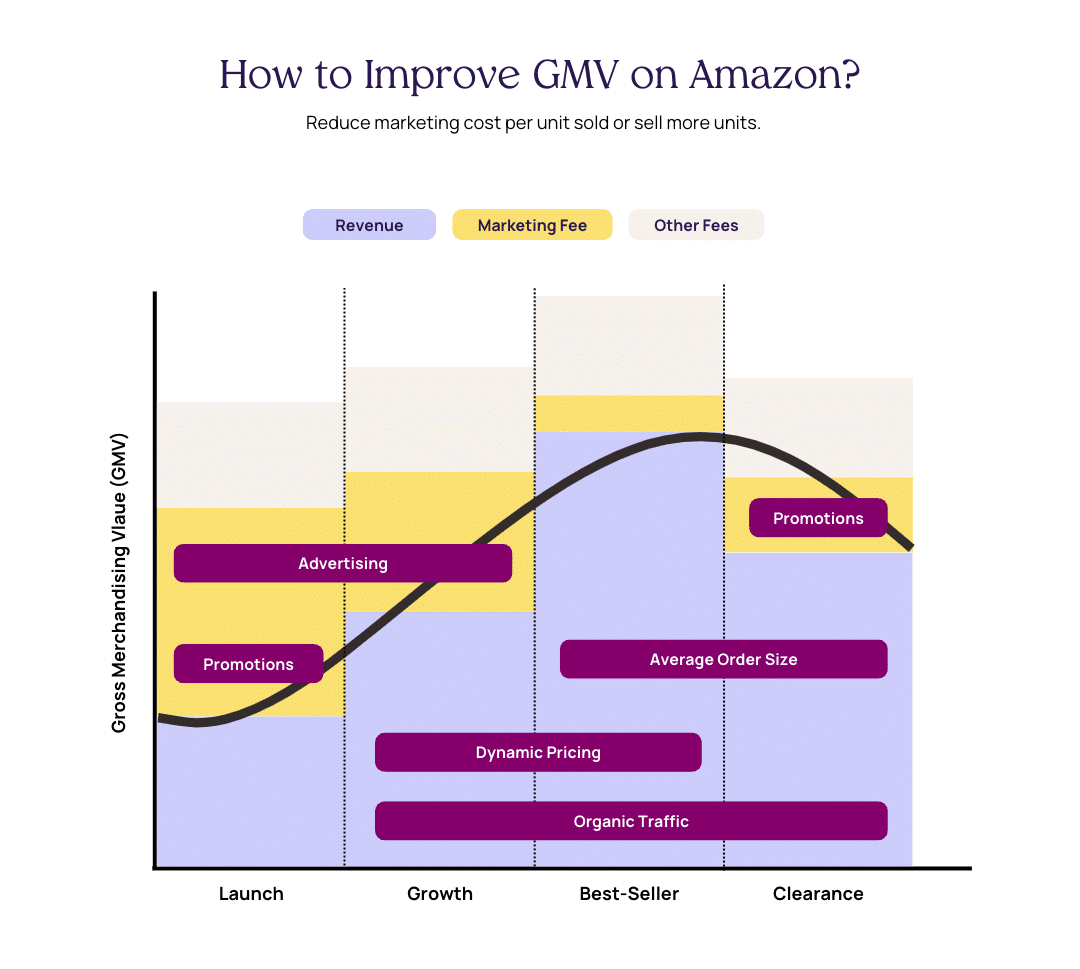
Here are several ways to improve your Amazon GMV:
1. Getting organic traffic
A better way to improve your GMV share is by getting organic traffic, sales, and growth. Once you start ranking in Amazon search results, you get organic visibility, traffic, and high-margin conversions.
To get in the top search results, you need to optimize your product listing for the most relevant keywords and get your product details page retail ready i.e. optimized for conversions. You can follow a complete list of optimizations including getting high-quality images and designing compelling A+ content.
The more your product listing improves and gets positive reviews/ratings, the faster it ranks higher in search results. It is important to know that the biggest factor in ranking higher is having a high conversion rate.
If you want to boost traffic to your product listing and get some sales, you can run Amazon ads or promotions.
2. Optimizing ACoS
Advertising costs will lower your GMV-revenue percentage, but increase your total GMV through increased sales. If you run Amazon ads, you need to continuously optimize your campaigns for a lower Advertising Cost of Sale (ACoS).
Lower ACoS is correlated with an increase in GMV-revenue percentage. By optimizing your advertising campaigns, your CPC will go down or your conversion rate will go up leading to fewer costly clicks that bring in more revenue.
You can lower your ACoS by allocating your budget to more relevant, high-converting keywords. While most converting keywords have a higher CPC, you can automate campaigns to avoid high CPC keywords that don’t convert. This will enable you to use your data to improve your GMV.
Trellis’ advertising and merchandising automation platform will help you to execute tasks just like this. With full-funnel targeting automation, you can:
- Run sponsored product ads to target high-intent search terms
- Run sponsored brand ads to increase New-to-Brand sales and support repeat sales growth.
- Cross-sell and upsell your audience at the bottom of the funnel to increase your average order size with Sponsored Display ads.
This full-funnel targeting helps you regain your GMV through increased sales velocity and profitability.
3. Running promotions
While discounts, deals, and coupons will decrease your revenue share of GMV initially, it will increase your total GMV through more sales. These promotions incrAlthough Amazon FBA feesease visibility across Amazon pages and search results, attracting customers and driving sales. It’s important to remember that FBA fees vary significantly by product size, weight, and category, and that sellers should calculate their specific FBA fee impact before assuming it is the right fulfillment model for every product.
Promotions can be run at any stage of the product lifecycle from launching a product to clearing out inventory. It helps your product build a sales history and gather positive reviews/ratings. By offering limited-time discounts or other promotional incentives, you can entice customers to make additional purchases, leading to increased sales volume.
4. Offering competitive pricing
Due to high competition on Amazon, pricing can be tricky for Amazon sellers. Lower prices increase sales but tighten profit margins. Increasing prices reduce sales, but improve margins.
To get more sales with higher margins, sellers need to run several tests to find their optimal price. However, that can be inefficient too, as competitors also continuously change their prices.
Dynamic pricing offers price analysis and auto price adjustments that will save you time and money, particularly if you have a range of products.
To make an impact on your GMV, you can use dynamic pricing that finds the balance between sales and profit margins, and also lets you track competitor pricing.
5. Increasing the order size
While the above ways improve your overall GMV through increased sales velocity, you can also increase your GMV-revenue percentage. If you are keeping 50% of your GMV the following ways may help you keep 55% by simply raising the average order size.
Through Amazon’s FBA program, leverage your product’s appeal to customers. By utilizing FBA, you can offer Prime-eligible products, benefiting from Amazon’s reputation for fast and reliable shipping. The convenience of free and fast shipping encourages customers to buy your product. Although Amazon FBA fees will decrease your GMV-revenue percentage, they will help you convert more sales leading to a better ranking.
Moreover, you can encourage customers to increase their average order value (AOV) by offering bundled products or bulk-selling options. Bundling related items together allows you to provide more value and discounts to your customers. By incentivizing customers to buy more in a single transaction, you can significantly impact your GMV.
Want actionable eCommerce tips delivered straight to your inbox every month?
Subscribe to The Climb, Trellis’ monthly newsletter packed with quick updates and insights designed to help your business grow.
How Trellis Can Help Grow Your Amazon GMV
Growing GMV on Amazon requires more than running ads or dropping your price. It takes a coordinated strategy across advertising, pricing, and product content, all working together.
Trellis is built for exactly that. Its AI-powered advertising automation helps you maximize sales velocity by targeting high-converting keywords, reducing wasted ad spend, and running full-funnel campaigns across Sponsored Products, Sponsored Brands, and Sponsored Display. Dynamic Pricing takes the guesswork out of finding the right price. It monitors competitor pricing in real time and adjusts your price automatically to protect your Buy Box position, maintain MAP compliance, and balance sales volume with profit margins.
Product Content Optimization connects your organic listings to your top-converting ad keywords, improving discoverability and conversion rate at the same time. And with Market Intelligence dashboards, you can track your GMV trends, Share of Shelf, shopper behavior, and key performance indicators (KPIs) in one place, so you always know what’s working and what needs attention.
Whether you’re in the early stages of building sales history or managing a mature catalog at scale, Trellis gives you the tools and data to grow smarter. Book a demo to see how it works for your business.
Read more: Razor Group Achieves Operational Efficiency and Predictability with Trellis Dynamic Pricing
The GMV Trap: Why More Sales Doesn’t Always Mean More Profit
Here is a scenario a lot of Amazon sellers know well.
You run a Lightning Deal or a deep coupon promotion. Your units sold triple. Your GMV looks incredible for the week. You feel good about it. Then you look at your actual margins and realize you made less money than a normal week at full price.
That is the GMV Trap.
The GMV Trap happens when sellers prioritize sales volume above everything else, inflating their GMV through deep discounts or unchecked ad spend, without a corresponding improvement in profitability. GMV goes up. Profit does not. Sometimes profit goes down.
There are three common ways sellers fall into it.
Over-discounting
Coupons, Lightning Deals, and percentage-off promotions all have their place in a smart Amazon strategy. The problem starts when discounting becomes a default tactic rather than a deliberate one. Deep, repeated discounts can erode your price floor over time, and they can train shoppers to wait for your next sale instead of buying at full price. A 30% coupon that drives volume might look good in your GMV report and terrible in your profit report.
Unchecked Ad Spend
Pay-per-click (PPC) advertising increases your total GMV by driving more traffic and sales. But if your Advertising Cost of Sale (ACoS) is climbing alongside your GMV, you are paying more and more to generate each dollar of revenue. At a certain point, you are effectively paying Amazon to grow their platform metrics, not yours. Always watch the relationship between your ad spend and your GMV-to-revenue ratio — not just the headline GMV number.
Chasing Best Seller Rank (BSR)
BSR is a means to an end. The end is profitable, sustainable sales. Sellers who obsess over ranking without tracking profit per unit often find themselves ranked highly on a product that is barely breaking even. Rank matters — but only if the sales that come from it are actually making you money.
How do you avoid it? Track GMV, revenue, profit margin, and ACoS together, every single reporting period. If GMV is growing but margin is shrinking, that is a warning sign. If ACoS is rising faster than GMV, that is a warning sign. Tools like dynamic pricing can help you avoid reactive discounting by automatically finding the price that balances sales velocity with margin, without you having to manually intervene every time a competitor drops their price.
GMV tells you how much you sold. Profit tells you whether it was worth selling.
How External Traffic Boosts Your Amazon GMV
Most Amazon sellers focus entirely on traffic that originates inside Amazon, search results, Sponsored Products ads, and category browse pages. That is a reasonable starting point. But it leaves a significant growth lever untouched.
Amazon actively rewards sellers who drive traffic to the platform from outside it. When a shopper arrives at your listing through an external source and converts, it sends a strong relevance signal to Amazon’s A9 algorithm. That signal can improve your organic search ranking, which drives more organic traffic, which drives more sales. It feeds the flywheel.
Before diving into specific channels, it is worth knowing about Amazon Attribution, a free tool available to Brand Registered sellers that lets you track which external channels are actually driving clicks and conversions on your listing. Without it, you are essentially spending on external traffic without knowing what is working. Set it up first.
Here are the four main external traffic channels worth building into your strategy.
Social Media Advertising
Paid ads on Meta (Facebook and Instagram) and TikTok are the most direct way to drive external traffic to your Amazon listing. You are targeting shoppers outside Amazon’s ecosystem and sending them straight to your product page, bypassing the competition on Amazon’s search results entirely. TikTok in particular has become a powerful product discovery channel. If you are looking to scale your creator and influencer partnerships on TikTok, Trellis’ TikTok Reach feature puts that process on autopilot.
Email Marketing
If you have a direct-to-consumer (DTC) site or a Shopify store alongside your Amazon presence, your email list is one of your most valuable assets for driving Amazon GMV. Sending existing customers back to your Amazon listing for reorders, especially for consumable products enrolled in Subscribe & Save, drives conversion at a very low cost per click. These shoppers already know your brand, so conversion rates tend to be strong.
Influencer and Creator Marketing
Micro-influencers in your product’s niche can drive highly targeted, qualified traffic to your listing at a lower cost than traditional paid advertising. A creator with 20,000 highly engaged followers in your category will often outperform a broad paid social campaign. This is especially effective at the launch stage when you need early sales velocity to build ranking momentum.
Content Marketing
Blog posts, YouTube videos, and how-to guides that rank in Google search results and link to your Amazon listing are a slower-burn strategy but one that compounds over time. A well-ranked piece of content can drive steady traffic to your listing for months or years without any ongoing spend.
How to Calculate Your Amazon GMV
The formula itself is straightforward. Here it is:
GMV = Number of Units Sold x Sale Price
So if you sold 500 units of a product at $25 each in a month, your GMV for that product is $12,500.
For sellers with multiple products, you calculate GMV per product and add them together.
Here is a quick example:
- Product A: 200 units x $20 = $4,000
- Product B: 150 units x $45 = $6,750
- Product C: 80 units x $60 = $4,800
- Total GMV: $15,550
There is a second version of the formula that is worth knowing because it connects GMV directly to a metric you can influence:
GMV = Number of Orders x Average Order Value (AOV)
AOV is calculated as: Total Revenue / Number of Orders
This version matters because AOV is something you can actively improve through bundling, upsells, free shipping thresholds, and Subscribe & Save. When you frame GMV as orders multiplied by AOV, it becomes clear that growing GMV is not just about selling to more people, it is also about getting each customer to spend more per transaction.
A few things to keep in mind when calculating GMV:
- GMV is always a gross number. Do not deduct Amazon fees, shipping costs, discounts, or returns when calculating it. Those deductions come into play when calculating revenue and NMV.
- Returns and refunds are not subtracted from GMV. If you want to account for those, calculate NMV instead.
- Pick a consistent time period. Monthly GMV is most useful for tracking trends. Quarterly and annual GMV are better for benchmarking and reporting.
Most importantly, do not just calculate GMV as a snapshot. The trend line matters far more than any single number. Track it month over month, identify what is driving changes, and use it alongside your ACoS, conversion rate, and profit margin to get the full picture.
What Is a Healthy GMV Growth Rate?
There is no single universal benchmark here, and anyone who tells you otherwise is oversimplifying. That said, there are useful reference points.
At the marketplace level, Amazon’s third-party GMV grew at roughly 9% in 2025, according to Marketplace Pulse. That is the baseline for the platform you are selling on. It also reflects a maturing marketplace, double-digit growth rates were the norm for most of the past decade, but scale naturally moderates growth.
For individual sellers, what counts as “healthy” depends on three things: your product lifecycle stage, your category, and your competitive environment.
New Product or Launch Phase
This is where GMV growth should be most aggressive. If you are building sales history and trying to establish organic rank, growing GMV by 20–50% month over month is not unrealistic — and at this stage, it is more important than margin. You are planting seeds, not harvesting yet.
Growth Phase
Once your product has traction and consistent reviews, the focus shifts. A 10–25% month-over-month GMV growth rate is solid here. You should also start paying attention to your GMV-to-revenue ratio alongside volume, are you growing efficiently, or are you buying growth through discounting and high ad spend?
Mature or Established Products
At this stage, 5–10% consistent monthly growth is a strong result. The emphasis moves to profitability, catalog expansion, and protecting your organic rank rather than chasing raw volume.
A flat or declining GMV is worth investigating immediately. It can signal a few different things: a pricing issue, a listing that needs optimization, inventory stockouts hurting your sales velocity, or increased competition pushing you down in search results. Do not ignore it.
One important nuance: GMV growth rate should never be read in isolation. A rising GMV paired with a rising ACoS often means you are purchasing growth through ad spend, not earning it organically. A rising GMV with a declining conversion rate might mean your traffic has increased but your listing is not converting, which points to a content or pricing issue. Always read GMV growth alongside ACoS, conversion rate, and profit margin together.
Consistent, incremental growth beats unsustainable spikes. A seller who grows GMV 10% every month for a year is in a far better position than one who doubles their GMV in Q4 through aggressive discounting and then stalls out.
Closing Thoughts on GMV
While cutting down on marketing costs to increase profits can help improve the GMV-revenue percentage you get from Amazon, you should also consider the benefits of increasing overall sales to increase total GMV. Through the flywheel effect, this might be the fastest way to grow your business. Higher sales convert more reviews for your product listing helping you increase your conversion rate, thus improving organic traffic.
It is important to look at your data and speak with your strategist to analyze whether you should focus on overall profitability or if on a marketplace like Amazon, you should focus on overall sales volume. By increasing GMV month over month, you ensure that you are improving your net income and the metrics that matter.
Follow the generators of GMV in your merchandising funnel to separate yourself from your competitors and create more customers. Amazon is saturated and it continues to be difficult to win. But, while the competition is high, with the right strategy and tools, the reward is even higher.
If you’re ready to start growing your Amazon GMV more efficiently, Trellis gives you the AI-powered tools to do it, from smarter advertising to dynamic pricing to the analytics that keep you one step ahead.
