



Same metric, different math: why RoAS doesn't compare across Amazon and Walmart

Walmart's RoAS beats Amazon's on the monthly report, and someone asks to move budget. Before anyone does, check that the two numbers measure the same thing, because Amazon vs Walmart RoAS is often a comparison of two different definitions.
Agencies see it in every client report. One RoAS column, pulled from Amazon, Walmart, and TikTok Shop, can hold three definitions at once, and the client reads it as one number.
Both platforms divide ad-credited sales by ad spend. What changes is which sales get credit, for how long after the click, and how the auction sets the price of that click.
Quick Answer
Amazon and Walmart RoAS use the same formula, but each platform fills it in differently. Amazon Sponsored Products credits sales for 7 days by default for sellers; Walmart reports at 3, 14, or 30. Walmart can count other brands' products as "related" sales. And each auction prices the click its own way. Before you compare, pull both channels at the same window, count the same products, and look at TACoS first, since it doesn't depend on attribution.
RoAS is built from three inputs and one rule
RoAS is conversion rate times order value, divided by what each click costs. The attribution window is the rule that decides which orders make it into the numerator. (For benchmarks on Amazon alone, see what is a good Amazon RoAS.)
RoAS = (conversion rate × average order value) ÷ CPC
Here is that math on a real account: a US consumables seller managed on Trellis, 91 days from Jul 26 to Oct 24, 2026, Amazon only.
| Input | Value |
|---|---|
| Ad spend | $91,403 |
| CPC | $0.48 |
| Conversion rate (clicks to ad orders) | 13.4% |
| Average ad order value | $22.15 |
| RoAS (13.4% × $22.15 ÷ $0.48) | 6.2 |
| Attribution window | 7 days (Sponsored Products, seller) |
Every one of those inputs behaves differently on Walmart. The auction prices the click differently, the traffic converts differently, order values often run lower, and the window that fills the numerator is a different length. Change any one of them and the same campaign reports a different RoAS.
Check the window before you compare the result
A longer attribution window credits more orders to the same click, so the same campaign reports a higher RoAS. Put a 7-day Amazon number next to a 14-day Walmart number and Walmart gets an extra week of credit before either ad has done anything different.
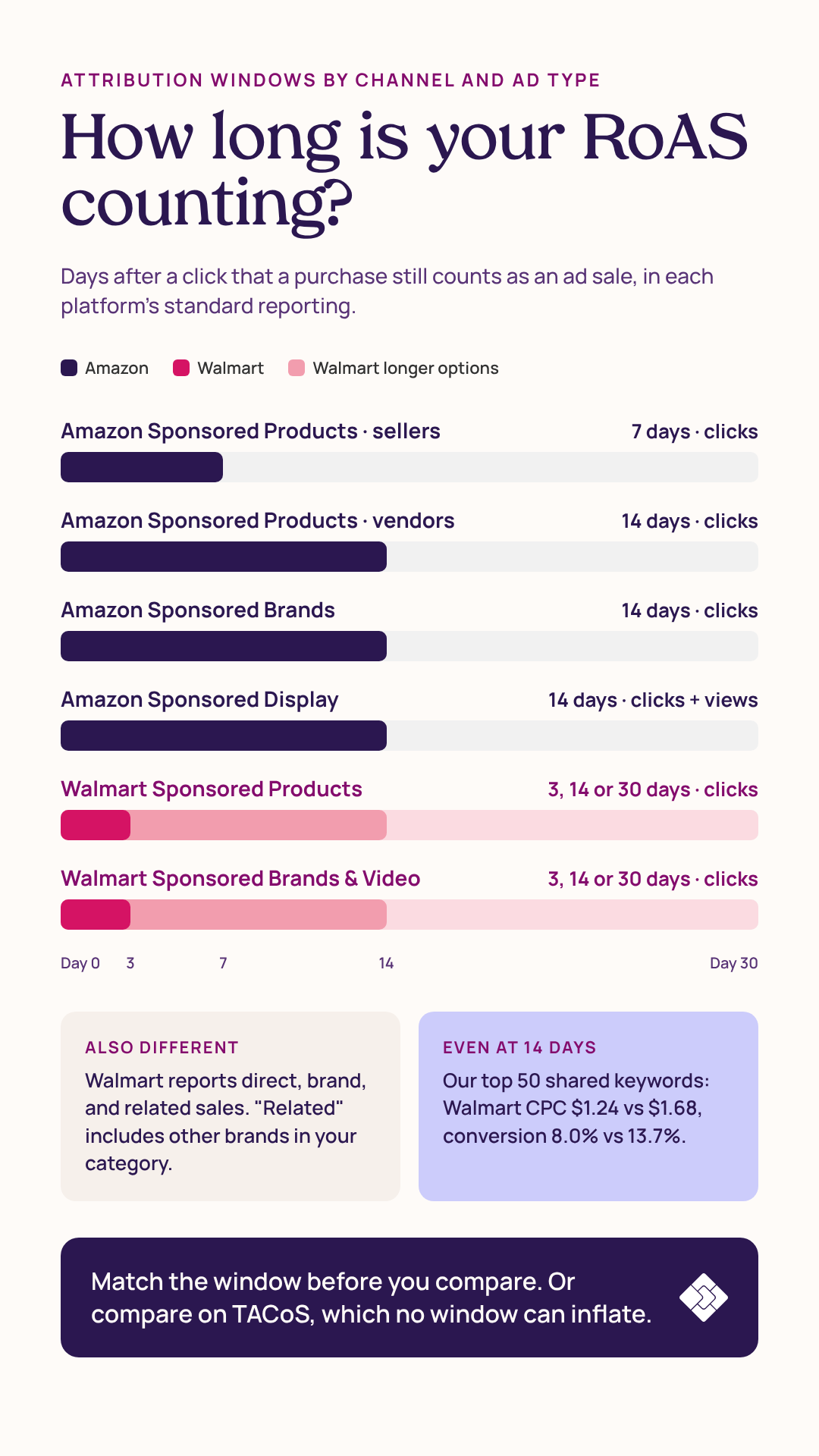
The defaults hide a few wrinkles. Amazon Sponsored Products reports at 7 days for sellers and 14 for vendors, so a hybrid 1P/3P brand sees two windows for one ad type, and the Ads API also returns 1, 14, and 30-day figures. Sponsored Brands and Sponsored Display report at 14, and since Jan 1, 2026, vCPM Display credits orders on a shopping-signal last-touch model rather than blind view-through. Walmart Sponsored Search can be pulled at 3, 14, or 30 days; which one a dashboard shows depends on the tool, 14 is a common default, and Qore's Walmart reports use 14.
The gap shows up inside Amazon too. Sponsored Brands and Sponsored Products sit side by side in the same console with different windows, so a budget shift from one to the other can be driven by the counting rule rather than the ads.
A longer window isn't more accurate, either. It's more generous. Every extra day credits the ad with orders that might have happened anyway, so a 14-day RoAS is the upper end of what the ad did, not a sharper measurement of it. Separating the two takes an incrementality test.
Rather than pick the "right" window, compare on the same one: pull Amazon at 14 days through the API or Amazon Marketing Cloud, or pull Walmart at the window that matches your Amazon report, and write the window next to every RoAS you show.
Decide what counts as an ad sale, then hold it fixed
The window is one definition. Which products count is the other, and it moves RoAS just as far.
On the same seller account, over the same 91 days and the same $91,403 of spend, RoAS reads 6.2 when any of the brand's products bought after a click count, and 4.1 when only the exact advertised item counts. Same ads, same money, a 51% swing from one reporting choice.
| What counts | Ad sales | RoAS |
|---|---|---|
| Any of the brand's products (halo included) | $562,270 | 6.2 |
| Only the advertised item | $371,186 | 4.1 |
Walmart splits this three ways. Its reporting fields separate direct sales of the advertised item, brand sales of other items from the same brand, and related sales of other brands in the same category. A "total attributed sales" column that includes related sales is crediting your ad with purchases of a competitor's product.
Before comparing, choose the level (advertised item, brand, or category) and pull both channels at that level.
Know who sets your CPC: the auction or the platform
Both Amazon and Walmart describe their search auctions as second-price, where your bid is a ceiling and the winner pays less than its maximum. The details differ, and on both platforms the clearing price is set by the platform, not visible to you.
Amazon: a penny over the next bid, as described
Amazon has long told advertisers its Sponsored Products, Sponsored Brands, and Sponsored Display auctions are generalized second-price: the winner pays one cent more than the next-highest bid, with relevance weighed alongside bid. On Aug 31, 2026, the FTC and 22 states sued, alleging that since 2019 Amazon added an undisclosed surcharge it called internally a "soft reserve price," and that winners were charged their own bid close to 80% of the time. Amazon calls the complaint misguided and says its relevance-first auction saved advertisers more than $8 billion from 2021 to 2025. The case is unresolved.
For reporting, the practical point stands either way: an Amazon CPC sitting at or near your bid is worth flagging, and comparing CPC to bid by keyword is a check any operator can run.
Walmart: "the amount necessary to win"
Walmart moved Sponsored Products and Search Brand Amplifier to what it calls an advanced second-price auction in June 2022. Walmart's own guide does not promise a one-cent increment. It says the platform picks the most relevant ad, then sets the CPC after considering competing relevant bids, and the winner pays the amount necessary to win, which may be less than the maximum bid.
Relevance comes first on Walmart. The guide names shopper intent, contextual relevance, item page quality, and the product's sales history on Walmart. A stronger listing can win at a lower price; a weak one can lose to a lower bid.
Two more differences show up in the numbers. Walmart enforces bid floors (commonly cited at $0.20 for automatic and $0.30 for manual campaigns), which matter for low-priced items. And Walmart's onsite display buys run on a first-price, cost-per-thousand basis, so they don't share the search auction's pricing at all.
| Amazon search ads | Walmart search ads | |
|---|---|---|
| Stated model | Generalized second-price | Advanced second-price |
| What the winner pays | One cent over the next bid, as described by Amazon (contested by the FTC) | The amount necessary to win, set by Walmart after weighing relevant bids |
| Winner chosen on | Bid and relevance | Relevance first, then bid |
| Bid floor | $0.02 | About $0.20 automatic, $0.30 manual |
A cheaper click can still lose money
Walmart clicks often cost less, but RoAS depends on what those clicks convert into. Fewer advertisers bidding on a query keeps the clearing price down; it also means less traffic, and traffic that converts at its own rate on a listing that may have been copied over from Amazon. The two marketplaces reward different things, which we cover in selling on Walmart vs Amazon.
Published benchmarks put Walmart Sponsored Products CPC at roughly $0.50 to $1.00 against $0.81 to $1.30 on Amazon, and another agency puts the ranges at $0.35 to $0.75 and $0.85 to $1.20. Treat those as a shape, not a target: the Amazon account above runs at $0.48, below both Amazon ranges, because category and price point move CPC more than platform does.
The formula shows why a lower CPC is not enough on its own. If Walmart clicks cost 30% less but convert 20% lower on a basket that is 15% smaller, RoAS barely moves. Price point compounds it, because a cheaper item keeps less margin per order and needs a higher RoAS just to break even.
| Illustrative product | Price | Margin before ad spend | Break-even RoAS |
|---|---|---|---|
| Item A | $40 | 35% | 2.9 |
| Item B | $20 | 25% | 4.0 |
| Item C | $12 | 18% | 5.6 |
Break-even RoAS is 1 divided by margin before ad spend (how to calculate contribution margin). If the same brand sells cheaper pack sizes on Walmart, a Walmart RoAS that looks healthy next to Amazon can still be under water.
Same keyword, same window: the cheaper click still converts less
Our own data shows it, even with the windows matched. We pulled the 50 biggest keywords that brands on Trellis bid on in both Amazon and Walmart US ads, over roughly 11 weeks ending mid-October 2026, counting both sides at 14 days.
| Same keyword, 14-day window | Amazon | Walmart |
|---|---|---|
| CPC | $1.68 | $1.24 |
| Conversion rate | 13.7% | 8.0% |
| RoAS | 3.35 | 3.58 |
Walmart's click was cheaper on 35 of the 50 keywords, and its conversion rate was lower on 35 of them too. The two roughly cancel out. Among the 18 keywords with real spend on both sides, Amazon still posted the higher RoAS on 12.
The gap is sharpest where the click is cheapest. "Bathroom scale" cost $0.63 a click on Walmart against $2.99 on Amazon, yet converted at 5.2% vs 24.8%, and its Walmart RoAS came in at 1.27 against 2.74. "Food scale" followed the same pattern: a third cheaper per click, a third the conversion rate, and half the RoAS. It runs the other way too. "Prenatal" cost less than half as much per click on Walmart and converted nearly as well, so Walmart won at 3.29 vs 1.80.
A cheap click is only cheap if it converts. When it doesn't, look at the listing and relevance before the bid.
Line the numbers up before you move budget
Four questions settle most mismatches before a single dollar moves.
- Same attribution window on both? A longer window credits more orders to the same ads, so match the days before you read the result.
- Same products counted? Advertised item only, the whole brand, or (on Walmart) the category too. Pick one level for both channels.
- Clicks only on both? Display and video can credit orders from shoppers who never clicked. Leave view-through orders out of a search-ads comparison.
- Same ad types in each total? Sponsored Brands or Display mixed into one side changes the window and the math.
One more worth asking once those match: how much of each channel's ad sales came from new-to-brand customers versus repeat buyers? Both Amazon and Walmart report new-to-brand orders. A channel whose RoAS leans on shoppers who already buy from you is winning credit, not customers, and that changes what an extra dollar there is worth.
Then put both channels on one scorecard, led by the numbers no channel's attribution can inflate.
| Channel | Ad spend | Total sales | TACoS | RoAS (window, products counted) | CPC | Conversion rate | Avg order value |
|---|---|---|---|---|---|---|---|
| Amazon | (7d, advertised item) | ||||||
| Walmart | (14d, advertised item) |
TACoS, total ad spend over total sales, doesn't care which ad gets credit, so it is the fairest first comparison between channels. RoAS still earns its place on the scorecard, as long as its definition travels with it. Our free Amazon vs Walmart RoAS scorecard has these columns and a definitions sheet built in, with sample numbers filled in so you can see every result before you add yours.
Agencies rebuilding this scorecard for every client each month can start from our guide to building an Amazon Ads dashboard.
The bottom line for eCommerce teams
Amazon vs Walmart RoAS is only a fair fight when both numbers use the same window, count the same products, and include the same ad types. Until then, the higher number may just be the more generous one.
The free scorecard answers whether your Amazon and Walmart RoAS compare, what's driving the gap, and whether each channel clears break-even. Sample numbers are already filled in.
Get the Amazon vs Walmart RoAS scorecardHow Trellis lines up the channels
Qinetix, Trellis' ads automation platform, runs bids and budgets on Amazon and Walmart against a RoAS or ACoS goal you set for each channel, so a Walmart target can reflect Walmart's prices and margins instead of borrowing Amazon's. Qore pulls Amazon, Walmart, TikTok Shop, Shopify, and Google Shopping data into one workspace, where your team sets how each metric is defined once and every report after that uses the same definitions. Q helps you build the cross-channel scorecard as a skill; Qore runs it on schedule, with your team approving what goes out.
If your channel reports still mix windows and definitions, see it in action.
Sources
- FTC press release, Aug 31, 2026: FTC and states sue Amazon over ad surcharge
- Walmart Connect, Advanced second-price auction guide (June 2022)
- Amazon Ads attribution windows by ad type: Amazon Ads reporting documentation, as summarized by Intentwise and Openbridge
- Walmart Connect attribution windows and attributed-sales fields: Walmart Connect documentation, as summarized by Adverity and Osmos
- Trellis platform data: one US consumables seller, Jul 26 to Oct 24, 2026, Amazon Sponsored Products; and the 50 largest keywords bid on both Amazon and Walmart US by brands on Trellis, 14-day window, roughly 11 weeks ending mid-October 2026
Frequently Asked Questions
Part of the gap is often definitional. If Walmart is reported at 14 days and Amazon Sponsored Products at 7, Walmart counts an extra week of orders. Line up the window and the products counted before reading anything into the difference.
Walmart calls its search auction an advanced second-price auction. It picks the most relevant ad, then charges the amount needed to win given competing relevant bids, which can be less than your maximum. Walmart does not publish a fixed one-cent increment the way Amazon describes its own auction.
That is how Amazon has described its auction. An FTC complaint filed Aug 31, 2026 alleges a hidden surcharge meant winners often paid their own bid; Amazon disputes it, and the case is open.
Start with total sales and TACoS, which don't depend on attribution. Then compare RoAS only after the window and products counted match.
The one that matches across channels. Fourteen days lines up Amazon Sponsored Brands, Sponsored Display, and common Walmart reporting; Amazon Sponsored Products can be pulled at 14 days through the Ads API.